
















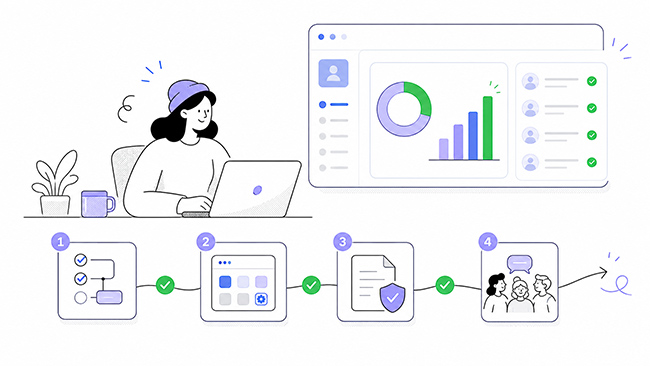

Article summary
Most internal documentation is written once and read rarely. This article walks through choosing the right pages to teach from, structuring them into lessons, and using assignments and progress tracking so training actually gets completed.
Every company running on Confluence has the same quiet problem: the knowledge is all there, but nobody can follow it. Pages pile up, links rot, and new starters are handed a space with hundreds of documents and told to read around.
Turning that material into a course is not about rewriting everything. It is about sequencing what already exists, filling the gaps with short lessons, and making completion visible.
In this article you will learn how to pick the content worth teaching, structure it into a course, and get it completed.
Choose the pages worth teaching
Start from the questions people actually ask, not from the pages you happen to have. The best source material answers a question a teammate has asked more than twice.
- Onboarding checklists and first-week guides
- Process pages that get linked in Slack over and over
- Tool guides your experts keep re-explaining
- Post-incident writeups with lessons worth keeping
If a page has not been touched in a year and nobody asks about it, it does not belong in your first course.
Structure pages into lessons
A course is a sequence, not a library. Break the material into lessons a learner can finish in five to ten minutes, and give each one a single job.
- Lead with a short video or a written lesson that frames the topic
- Follow with the reference material learners will come back to
- Close each section with a quiz that checks understanding, not memory
Peercraft's AI-assisted authoring can draft descriptions, summarise lectures, and generate quiz questions from your content, which keeps the busywork out of course creation.
Assign it, and make completion visible
Publishing a course changes nothing by itself. Completion happens when someone is expected to finish it and someone can see whether they did.
- Assign the course to the people who need it, with a due date
- Let managers see progress without chasing anyone
- Recognise completion with certificates and badges
This is the difference between documentation and training: documentation waits to be found, training asks to be finished.